 Bera
Bera pays network fees and supports validator staking on Berachain
Updated on
Bera is Berachain's native gas and staking token, traded under the ticker BERA. It pays transaction fees and supports validators that produce blocks. Depositing into a validator staking pool creates shares representing a stake. Choosing a route means comparing who controls withdrawals, how rewards reach the position, and when the deposited assets become available again.
A validator pool and the sWBERA Staking Vault serve different purposes. Their receipts, income sources, and exit rules differ. Keeping native tokens available for gas fees also matters because a staking position cannot pay transaction fees directly.
Check deposit and withdrawal terms before committing to a validator pool
A pool deposit normally exchanges native tokens for shares recorded against the depositor's account.
Would a validator pool meet your withdrawal requirements better than direct staking? Compare both using the same questions: who receives withdrawn funds, what records your entitlement, and which conditions delay access. A pool adds contract accounting and a managed withdrawal process. A direct validator deposit requires separate clarity about the withdrawal credentials and distribution arrangements.
Before authorizing a pool deposit, use these conditions to decide whether to proceed:
- The selected network and recipient contract match the intended validator pool.
- The transaction calls the pool's deposit operation instead of making an ordinary token transfer.
- The expected shares and their underlying value are visible and understandable.
- The remaining native balance covers the transaction's estimated gas cost.
- The pool's withdrawal conditions allow the access that you require.
While the transaction remains unsigned, you can change the amount or leave without depositing. After submission, check the receipt before treating the transaction as failed. Successful execution should correspond to a position in the selected pool. Compare its underlying value with the deposit, rather than expecting identical token and share counts.
If the confirmed receipt and displayed position disagree, retain the transaction identifier and check the same account against the pool contract. A display discrepancy does not justify repeating a completed deposit. Once execution succeeds, recovering the assets requires the applicable withdrawal process.
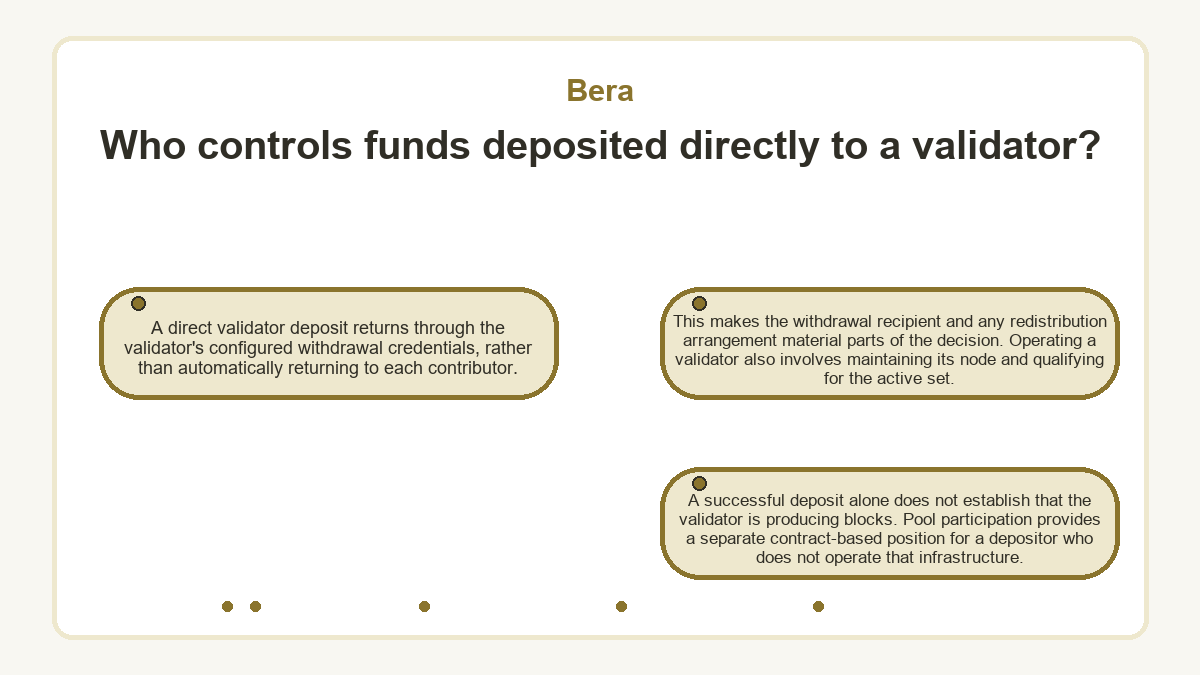
Who controls funds deposited directly to a validator?
A direct validator deposit returns through the validator's configured withdrawal credentials, rather than automatically returning to each contributor. This makes the withdrawal recipient and any redistribution arrangement material parts of the decision. Operating a validator also involves maintaining its node and qualifying for the active set. A successful deposit alone does not establish that the validator is producing blocks. Pool participation provides a separate contract-based position for a depositor who does not operate that infrastructure.
What separates the sWBERA vault from a validator pool?
The sWBERA Staking Vault earns income through the Proof of Liquidity Incentive Auction. Validator pools compound operator WBERA rewards and proceeds from their own separate incentive auctions. These are separate destinations, even though both accept BERA deposits.
The vault accepts native tokens or WBERA, their wrapped form. It issues sWBERA to represent the deposit. Native deposits are wrapped within the supported flow, so acquiring wrapped tokens first is unnecessary for that entry path.
Auction buyers pay WBERA to acquire collected incentive tokens. The vault receives its allocated share of those proceeds, which increases the underlying assets represented by its shares. Income therefore depends on incentive activity and allocation. The receipt itself does not establish a fixed return.
Unstaking creates a withdrawal request with a cooldown. The vault burns the queued shares, and the reserved assets stop compounding during that period. Completion releases WBERA. Native tokens for subsequent gas payments remain a separate requirement.
A validator pool's stBERA shares cannot be deposited into this vault. Moving between these positions requires accounting for the original position's exit conditions.
Pool shares record a claim on changing underlying assets
Validator staking pool shares, called stBERA, are non-transferable. They record participation in a particular pool. They do not provide an ordinary transferable token that can move between wallets or trade on an exchange.
The pool converts deposits into shares using its asset accounting. As rewards enter the pool, each share can represent more underlying tokens. The useful balance is therefore the amount that the shares represent, alongside the share count. Automatic compounding describes reward handling; it does not promise continuous growth or a particular market value.
Each validator pool has its own contract addresses. The deposit destination is the pool contract, while supporting contracts handle operator functions, rewards, and withdrawals. A common receipt name does not make positions in different pools interchangeable. The account, network, and exact pool determine which position a balance belongs to.
Commission and activation affect the return available to depositors
Validator commission applies to incentive distributions, while a protocol fee applies to eligible reward growth. Compare their charging bases as well as their percentages. Gas is a separate transaction cost. Pool activation also depends on stake requirements and competition for the validator set, so registration does not establish active earning status. These are live conditions: a commission setting, an activation threshold, or an incentive allocation can change. A displayed annualized return cannot establish the amount that a future deposit will earn.
When does a staking pool withdrawal become spendable?
A pool withdrawal becomes spendable after the request satisfies its finalization conditions and the assets reach the recipient. Submitting a request starts that process; it does not immediately restore a wallet balance.
Operator-side liquidity does not remove the staking pool's withdrawal finalization delay. On the supported partial-withdrawal path, available WBERA can cover some or all of the request. Any uncovered remainder follows the consensus-layer withdrawal path. The source of funds changes, while the request still observes its required delay.
The request block and the contract's delay determine when finalization becomes eligible. That relationship is more dependable than treating an approximate duration as an arrival promise. A pending request, an eligible request, and a completed withdrawal represent different states. Only completion and receipt establish that the tokens are available for another use.
Proof of Liquidity determines where rewards originate
Berachain uses staked native tokens to support block production and Proof of Liquidity to distribute economic incentives. Following the May 2026 upgrade, reward emissions use WBERA. The earlier BGT delegation boost no longer determines the per-block emission amount. Pool comparisons therefore need to consider reward allocation, attracted incentives, and commission within the applicable reward model.
Liquidity provision is another distinct use of the asset. Its trading fees arise from pool activity, and its position carries exposure to the assets deposited. Tokenomics affects supply and emissions across the network, but does not define an individual deposit's return. Native holdings, validator pool shares, and vault shares each expose the holder to different operating conditions.
A staking receipt can represent an accruing position while the underlying asset falls in market value. Access also remains subject to the chosen contract's withdrawal rules.
Frequently asked questions
Can I stake without operating a validator node?
A validator staking pool allows deposits without requiring each depositor to run a node. The operator maintains the validator infrastructure. Validator registration and activation requirements apply to that infrastructure; they should not be confused with the amount that an individual pool participant must deposit.
What happens if a staking pool contract is paused?
A pause can prevent operations protected by the contract's emergency controls. The affected actions depend on the deployed implementation and pause state. An interface that remains accessible does not establish that deposits or withdrawals can execute. A pause also does not itself prove that a displayed position has disappeared.
Is an sWBERA withdrawal request cancellable?
An sWBERA withdrawal request can be cancelled under the Staking Vault's cancellation mechanism. Cancellation mints replacement shares at the exchange rate that applies then. If the vault compounded while the request was pending, the replacement share count may differ from the original count.
Does an sWBERA withdrawal request expire after its cooldown?
An sWBERA withdrawal request remains valid after its cooldown ends. Missing the first eligible completion time does not invalidate the request. The reserved assets do not resume earning vault rewards merely because completion is delayed.
How can several sWBERA withdrawals be tracked separately?
Each sWBERA withdrawal request is represented by an ERC-721 NFT. Multiple requests can remain active simultaneously, so each has its own identity and eligibility timing. One completed request does not establish that another request has completed or become eligible.
Are token rewards enough to establish a profitable staking position?
Token rewards alone do not show whether a position is profitable in your chosen currency. The comparison also needs the asset's market value, applicable fees, and the amount recoverable through withdrawal. An increasing underlying token balance can coexist with a declining currency value.