 Bera
Bera withdrawal requests replace sWBERA shares with a pending asset claim
Updated on
Bera withdrawals from the sWBERA staking vault burn the requested shares and reserve the corresponding assets for a later payout. Those assets stop earning vault rewards while queued. An active NFT-based request can be cancelled, subject to the vault being unpaused, but cancellation calculates new shares at the current exchange rate. Completion instead pays the recorded receiver after the cooldown.
An active request leaves a choice between payout and renewed staking
If an NFT-based withdrawal remains active, its owner can cancel it to resume staking, or leave it queued for completion after the cooldown. Cancellation remains available after the waiting period, provided completion has not already consumed the request.
Request type matters. Legacy withdrawals use an account-based record and a separate completion method. The cancellation function takes an NFT request ID; it does not provide the same cancellation path for a legacy record. A missing NFT alone therefore does not establish that an older withdrawal disappeared.
Completion requires a successful payout transaction
Once the cooldown has passed, completion releases the reserved amount to the receiver stored in the request. The waiting period itself does not send funds.
A successful completion removes the active request and emits a completion event. Reconciliation should connect that transaction with the recorded amount, receiver, and payout asset. A disappearing interface row alone does not distinguish completion from cancellation. Likewise, a transaction that only queued the withdrawal proves that the request was created, not that its receiver received a payout.
Burned shares stop participating in vault compounding
The vault excludes assets reserved for pending withdrawals from its active asset accounting. The queued amount therefore stays separate from assets backing outstanding sWBERA shares. Rewards received afterward benefit the active staking position rather than increasing that pending claim. The request records an asset quantity, while the market value of that quantity can still change.
Will cancelling return the same number of sWBERA shares?
Cancellation can return a different share count because it converts the reserved asset amount using the exchange rate that applies when cancellation executes.
Cancellation mints new shares using the vault's deposit preview for the reserved asset amount. The original burned share count remains a historical value.
If each share represents more underlying assets when cancellation occurs, the same reserved amount purchases fewer shares. That reduction alone does not show a cancellation charge.
The comparison must use consistent units. Compare the underlying assets represented by the newly minted shares with the reserved assets, allowing for conversion rounding. Comparing only the original and replacement token counts omits the exchange-rate change.
Cancellation restores staking participation but does not recover the compounding missed while the assets were reserved.
The recorded receiver stays fixed while the payout form can change
Completion uses the receiver already stored in the withdrawal request, while its native-currency setting determines whether the transfer delivers BERA or WBERA.
The completion input selects the asset form
Native BERA
The vault unwraps the reserved WBERA and sends native BERA. A contract receiver must accept that native transfer for this operation to succeed.
Wrapped BERA
The alternative transfers WBERA directly to the same receiver. This avoids the native-transfer requirement, but the receiver still needs a usable way to manage the received tokens.
Neither setting changes the destination address. The completion function does not accept a replacement receiver, so choosing another payout form cannot correct an unwanted destination.
Transaction records survive the removal of an active request
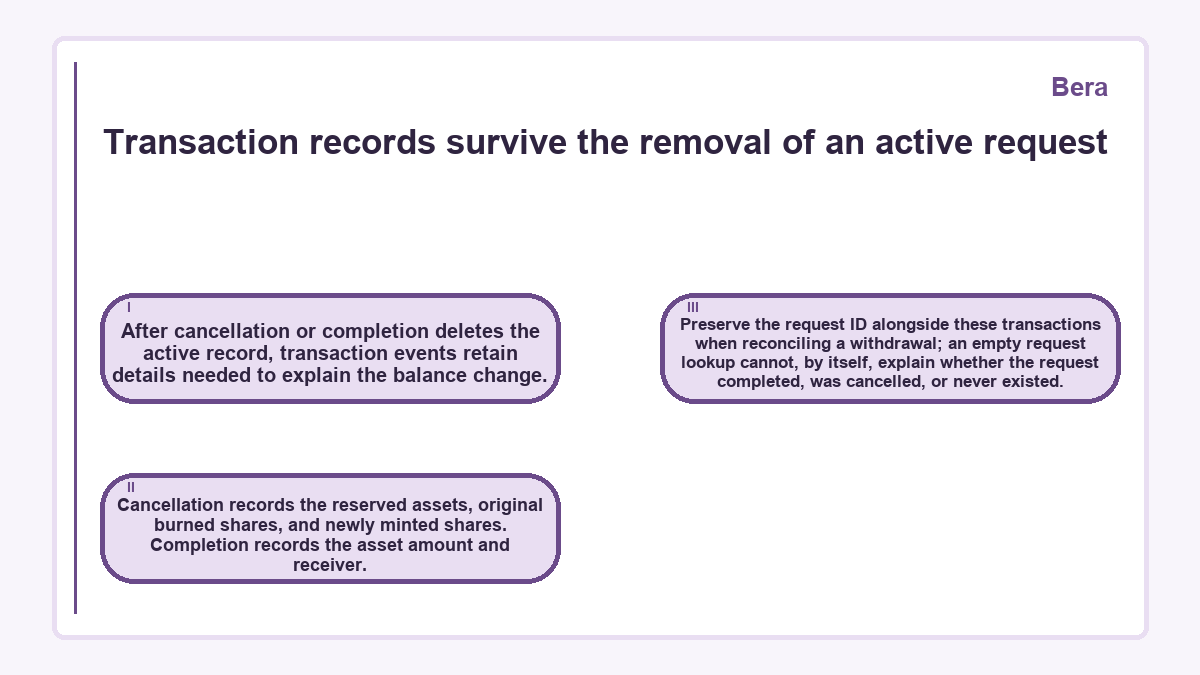
After cancellation or completion deletes the active record, transaction events retain details needed to explain the balance change. Cancellation records the reserved assets, original burned shares, and newly minted shares. Completion records the asset amount and receiver. Preserve the request ID alongside these transactions when reconciling a withdrawal; an empty request lookup cannot, by itself, explain whether the request completed, was cancelled, or never existed.
A rejected native payout requires a receiver compatibility check
Suppose completion fails because the recorded contract receiver rejects native BERA. The expected successful outcome is a transfer of the reserved amount and removal of the active request. A reverted transaction leaves that withdrawal unresolved.
A read-only request lookup and transaction simulation can distinguish receiver incompatibility from an unfinished cooldown or an inactive request. Keep the recorded amount and destination unchanged when comparing the native and wrapped payout options.
- If the request is no longer active, reconcile its completion or cancellation transaction before submitting another call.
- If the cooldown has not elapsed, changing the payout asset cannot make the request ready.
- If the receiver rejects native BERA, establish whether it can receive and subsequently use WBERA.
- If wrapped receipt is usable, simulate completion with the wrapped payout setting and review its gas estimate.
- If neither payout form is usable, assess the active request's cancellation option before making another paid attempt.
Changing the payout setting can resolve a native-transfer incompatibility without changing the claim's quantity. It also changes the work that the transaction executes. Gas used and the applicable gas price determine the execution cost; neither a previous estimate nor the withdrawal amount establishes a fixed retry fee. An included transaction that reverts can still consume gas.
A pause or unfinished cooldown blocks specific actions
The vault's pause condition blocks both completion and cancellation, while the cooldown separately restricts completion. An error caused by either condition does not establish that the reserved assets have vanished.
The withdrawal-request contract specifies a seven-day cooldown measured from the request timestamp. Its completion logic imposes no subsequent expiry deadline. Waiting longer does not restart rewards, and increasing transaction fees cannot override a contract pause or shorten the cooldown.
A completed request cannot be reopened through cancellation
Once completion succeeds, the request no longer exists for cancellation. Any later staking deposit creates a new position using its own execution-time conversion.
For an active request, cancellation also consumes the entire request record. A later withdrawal needs a new request and a new cooldown.
Bera: what people ask
Can another account complete my NFT-based sWBERA withdrawal?
Another account can call the NFT-based completion function once the request is ready and the vault permits completion. The payout still goes to the receiver recorded in the request. Calling completion does not grant the caller permission to redirect those assets.
Is NFT approval enough to let someone cancel my withdrawal?
Cancellation requires the caller to own the withdrawal-request NFT. The vault checks ownership directly, so an approved operator does not satisfy that requirement merely through approval. The replacement sWBERA shares go to the account that owns the request and successfully cancels it.
What distinguishes queueRedeem from queueWithdraw when creating a request?
queueRedeem starts with a quantity of sWBERA shares, while queueWithdraw starts with the underlying asset amount requested. The vault calculates the corresponding amount in the other unit. Both create a queued withdrawal rather than an immediate payout.
Does rejecting a cancellation signature remove my pending withdrawal?
Rejecting an unsigned cancellation transaction does not cancel the existing withdrawal. The contract changes only after a cancellation transaction executes successfully. A wallet prompt or rejected signature therefore cannot establish that shares returned to the staking balance.
Are sWBERA withdrawal-request NFTs transferable to another wallet?
The withdrawal-request NFTs are non-transferable. Their NFT format identifies individual requests, but it does not provide a way to sell or move a queued claim to another wallet. A transfer attempt cannot substitute for completing or cancelling the withdrawal.